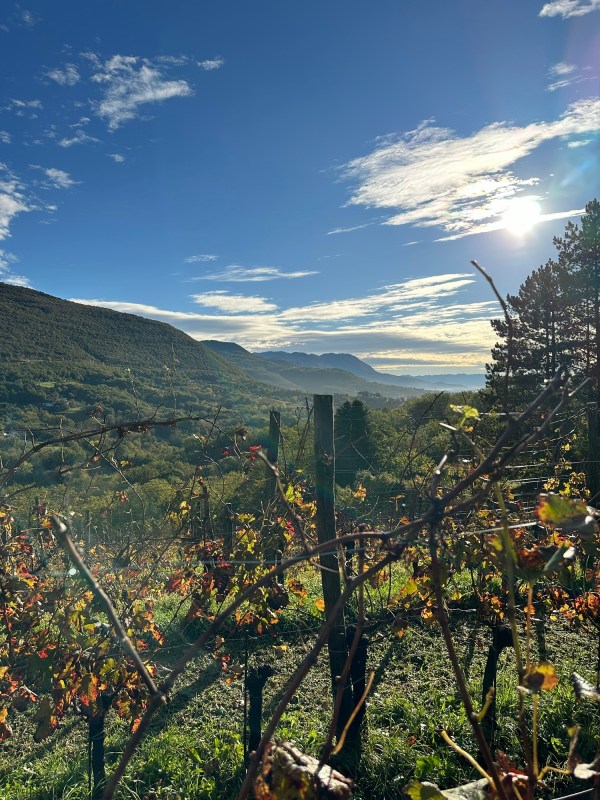
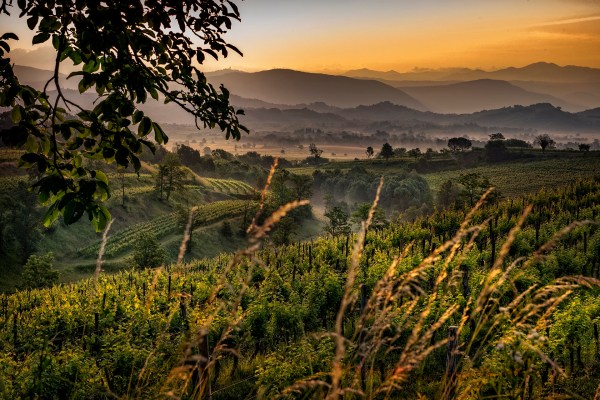
That intersection between history and evolution helps explain why Friulano was such an appropriate subject for the first Collio Evolution. The Consorzio deliberately framed the inaugural edition around the past, present and future of Friulano, with subsequent editions intended to place different Collio varieties in the spotlight. That framing seems particularly appropriate because Collio itself continues to evolve. There are grapes that belong to a place because they are widely planted. Others become inseparable from a region because, over generations, they come to express something deeper about its landscape, traditions and people. In Collio, that grape is Friulano. Friulano may not be indigenous to Collio in the strict ampelographic sense, but few grapes are more culturally indigenous to a place. Over generations, it has become woven into the identity of Collio: grown across its hillsides, poured in local osterie, embraced by many of the denomination’s leading estates and interpreted in styles ranging from bright and immediately approachable to concentrated, site-specific wines capable of developing beautifully for well over a decade. The Consorzio Tutela Vini Collio describes Friulano as a wine of tradition and a symbol of the denomination’s identity and history. Today it represents approximately 15% of Collio production, although its importance to the region extends far beyond those numbers. That made it an obvious choice to take centre stage at the inaugural Collio Evolution, held October 26 and 27, 2025. The new annual event was conceived as an exploration of the past, present and future of Collio, with a different grape variety taking the spotlight each year. For its first edition, organizers chose Friulano, the Consorzio calling it the wine of tradition and one of the most representative symbols of Collio’s identity and history. It was a fitting choice because understanding Friulano is, in many ways, essential to understanding Collio itself. Different producers are exploring different interpretations of Friulano. Some favour exceptionally clean, precise and mineral expressions. Others pursue longer lees ageing or greater textural development. Some employ skin contact, as seen in wines such as Picech’s Athena. Others continue to work within more traditional interpretations of the variety. Friulano also remains important within the broader language of Collio Bianco, where it can interact with varieties such as Ribolla Gialla and Malvasia Istriana. Yet none of these developments requires abandoning tradition. That is perhaps the larger message behind Friulano today. The grape has already survived changing borders, political regimes, winemaking fashions and even the loss of the name by which generations knew it. Its historical origins may be more complicated than the word “indigenous” sometimes implies, but after generations in these hills its connection to Collio is no longer merely agricultural. It is cultural. And that is why Friulano can feel so completely native to Collio even when its ampelographic history tells a more complicated story. The older wines at Collio Evolution added another important dimension to that relationship. They demonstrated that Friulano is not simply capable of representing Collio when young. Given time, it can reveal another side entirely, more savoury, textural, complex and contemplative, yet still recognizably connected to the grape and the hills from which it came. From a fresh young Friulano poured alongside the foods of Friuli to a single-vineyard wine still thriving thirteen years after harvest, the variety occupies an unusually broad spectrum. It can be familiar and profound at the same time. Choosing it to launch Collio Evolution therefore felt less like selecting the first grape in a rotating series than making a statement about what Collio considers important. Before looking toward the future, start with the variety that has helped define the region’s past. Start with Friulano. Cheers!
Friulano: The Grape at the Heart of Collio DOC