

December 1st, 2025
As featured on CTV Your Morning with Sommelier Matt Steeves
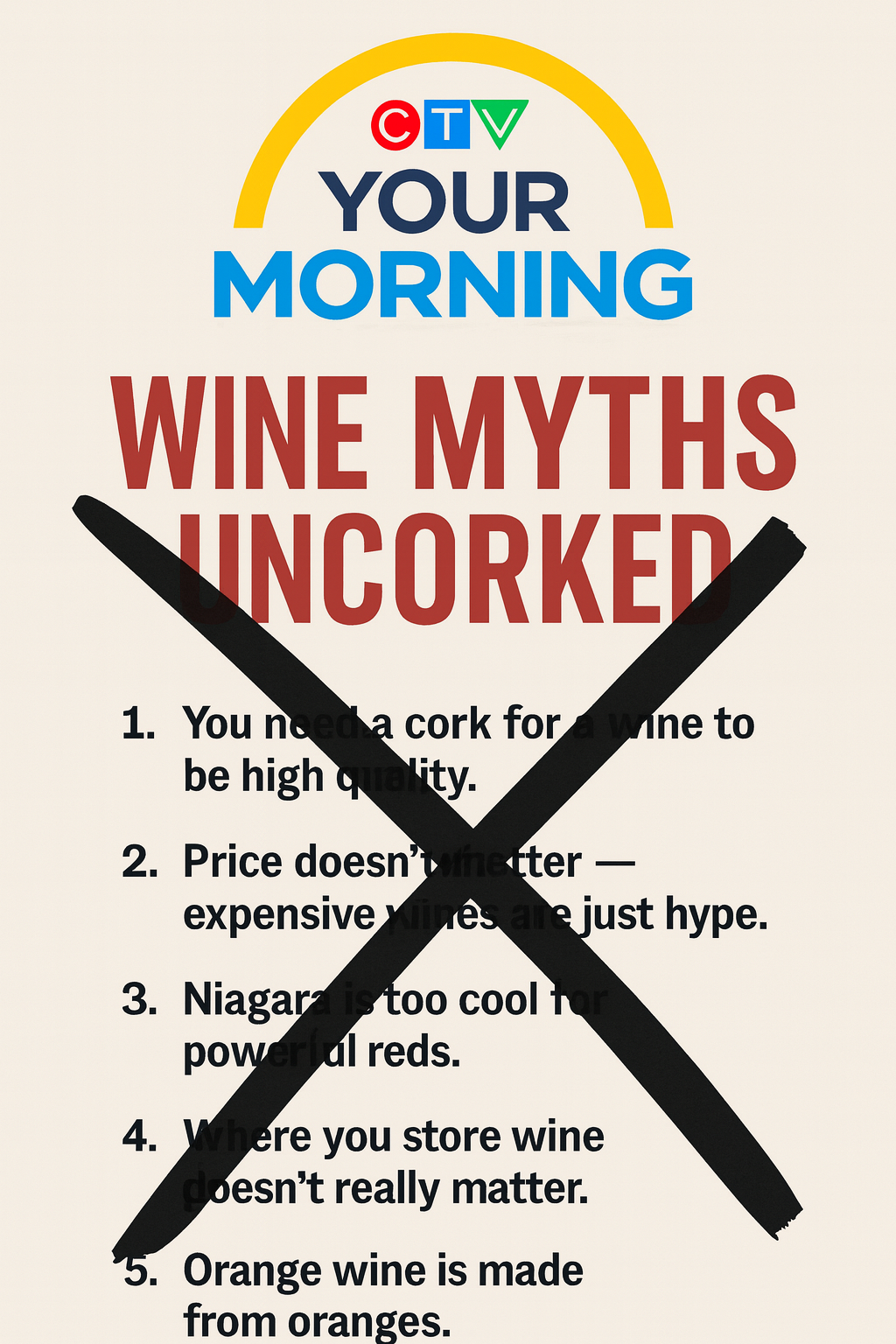
🍷 Wine Myths Uncorked: 5 Wines That Prove What Really Matters
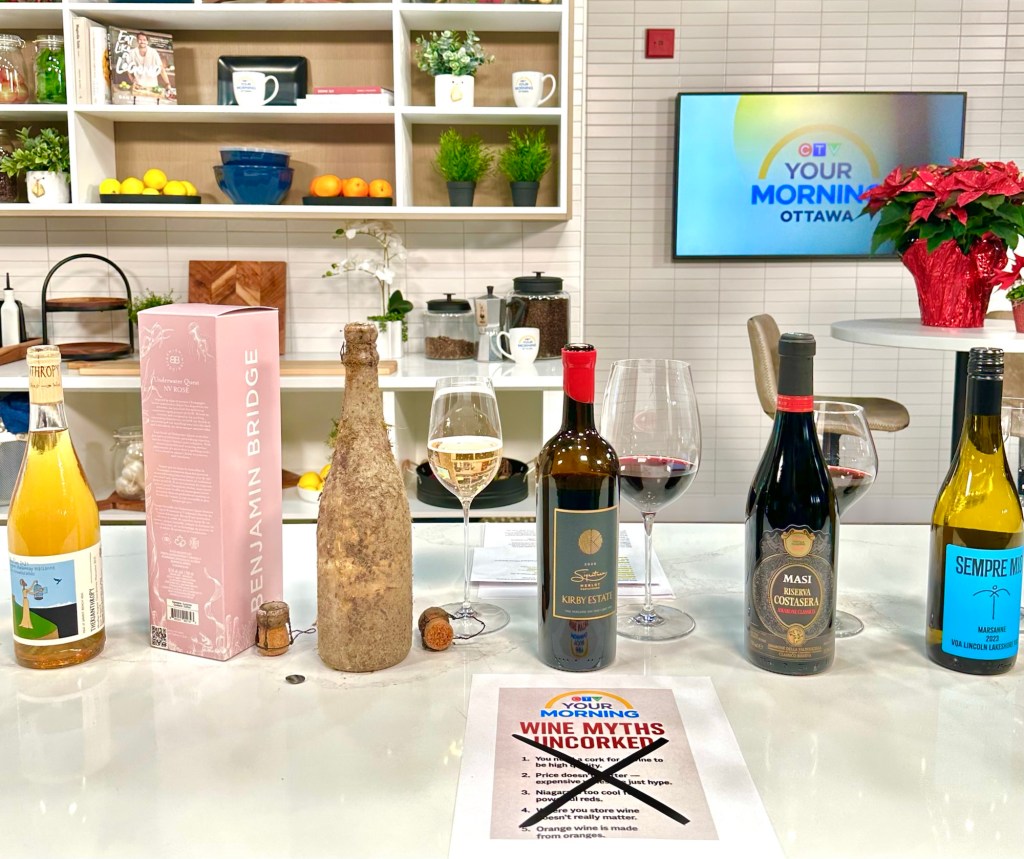
Wine shouldn’t feel intimidating — it should be enjoyable, expressive, and accessible to everyone. Yet myths persist about how wine should be sealed, served, stored, or selected. To help cut through that noise, I recently joined CTV Your Morning to debunk some of the most common misconceptions using five wonderful wines from Canada and Italy.
Each wine highlighted a different myth, and each proved it wrong in the most delicious way.
🧃 Myth 1: “You need a cork for a wine to be high quality.”
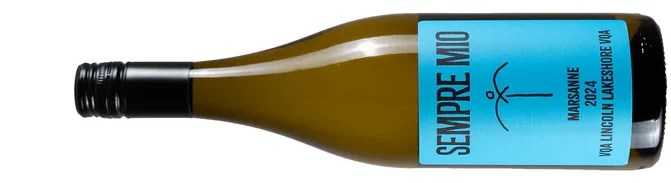
Wine Showcase: Sempre Mio Marsanne 2024, Lincoln Lakeshore VQA (Niagara), ON
Think screw caps signal inexpensive wine? Think again. This beautifully balanced Niagara Marsanne is sealed under a twist cap—not as a shortcut, but as a deliberate choice to protect its freshness and aromatic purity.
For decades, natural cork closures posed one of the greatest risks to wine quality. As recently as the early 2000s, up to 1 in 10 bottles were affected by cork taint, caused by contamination (often 2,4,6-TCA) that results in dull, musty aromas reminiscent of wet cardboard or a damp basement. When a corked bottle is opened, the wine is already damaged—flawed from the moment the tainted cork was inserted.
With the invention of the modern screw cap (Stelvin closure), winemakers finally had a solution. New Zealand and Australia were among the first premium regions to adopt screw caps across nearly all wines, including top-rated Rieslings and Syrahs. Today, many high-quality producers in Niagara, British Columbia, Oregon, and parts of Italy and France use screw caps to ensure consistency and eliminate this longstanding risk.
So, don’t be misled: a screw cap is often a sign of precision, not cost-cutting. It’s chosen to guarantee freshness, enhance longevity, and protect the purity of the wine inside.
✔ What matters is in the glass—not on the closure.
Sempre Mio Marsanne 2023 – Corey Mio’s debut wine from their Beamsville-based home vineyard in the Lincoln Lakeshore sub-appellation of the Niagara Peninsula. Corey Mio and wife Lena have established an impressive 12 acre Sustainable Certified (SWO) vineyard where until 2023 they were uniquely supplying some of Canada’s finest wineries and winemakers with their fruit, such as Thomas Bachelder, but for the 2023 vintage they also released their first of two wines under the label Sempre Mio. Sempre Mio Marsanne 2023 is a low production (105 cases) blend of 87% Marsanne, 13% Viognier (clone 1042), which was co-fermented following harvest on October 5th 2023. Natural primary and malolactic fermentation in a combo of 2nd fill and neutral French oak barrels for 11 months. The nose is very pretty and fresh, with honeydew melon, poached pear, quince, roasted nuts, and lanolin. Dry and deliciously creamy, with impressive refreshing acidity for this varietal, the palate shows layers of ripe orchard fruit, pithy citrus, chamomile, and custard, with a slight nuttiness on the finish. A unique wine from Niagara, and one that is certain to impress any palate given its approachable style yet very complex bouquet and flavour profile. Enjoy over the next 5-10 years with roast chicken, creamy pasta, or pan-fried trout with a butter sauce and honey-mango compote. Highly recommended! Tasted November 2024. 93+ points. Matt Steeves
👑 Myth 2: “Price doesn’t matter — expensive wines are just hype.”
➤ Wine Showcase: Costasera Riserva Amarone della Valpolicella DOCG 2018
While price alone doesn’t guarantee quality, certain wines, especially heritage styles like Amarone, Barolo, and Champagne, typically come with a higher price tag for good reason. These wines are inherently time-intensive, labour-demanding, and require extended aging before release. It’s common for them to take 4 to 10 years from harvest to market, representing a long-term investment in both craftsmanship and cellar space.
These iconic wine styles often start around $40+ because:
- Grapes are hand-harvested, frequently from low-yielding hillside vineyards.
- Amarone grapes undergo 3–6 months of natural drying (appassimento), requiring 2x more fruit to produce one bottle due to the withered ‘raisins’ having 40%-50% less volume/juice than freshly picked grapes.
- Barolo must age a minimum of 38 months before release (Riserva often 62+ months).
- Vintage Champagne requires a minimum 3 years of secondary fermentation/aging on its lees before disgorgement. Many Champagne producers often age their vitage and prestige cuvées for much longer, sometimes five to ten years or more, to develop greater complexity.
- Storage, oak maturation, and long-term climate control all add significantly to costs.
In short, you’re not paying for hype—you’re paying for years of meticulous work, exceptional fruit, and uncompromising quality.
✔ Between $40 and $100, many wines offer a notable step-up in concentration, complexity, balance, and longevity. In today’s globally competitive market, premium wines are priced fairly—you genuinely get what you pay for.
Amarone is living proof that you really do get what you pay for! Take for example this Riserva Amarone from Masi. The Masi Riserva Costasera Amarone launched in the LCBO last week, so run, don’t walk to pick up this fantastic Amarone which already has 7 years of age making it just that much more harmonious. Although it’s ready to drink now, it could also be cellared for an additional 2-3 decades. $84.95 at the LCBO.
Masi makes truly special wines and the Riserva Costasera Amarone della Valpolicella 2018 would be a fantastic occasion wine or gift. You could pair it with red meat, game, or mature cheeses. It’s also a great after-dinner wine for any continued celebration 😉
Masi is a leading producer of Amarone and has always interpreted the values of the Venetian regions with passion. Its history begins in 1772, the date of the Boscaini family’s first harvest in the prized vineyards of ‘Vaio dei Masi,’ a valley in the heart of Valpolicella Classico. Since then, Masi has expanded, little-by-little, with successive purchases in the best historical production areas of the Venetian regions.
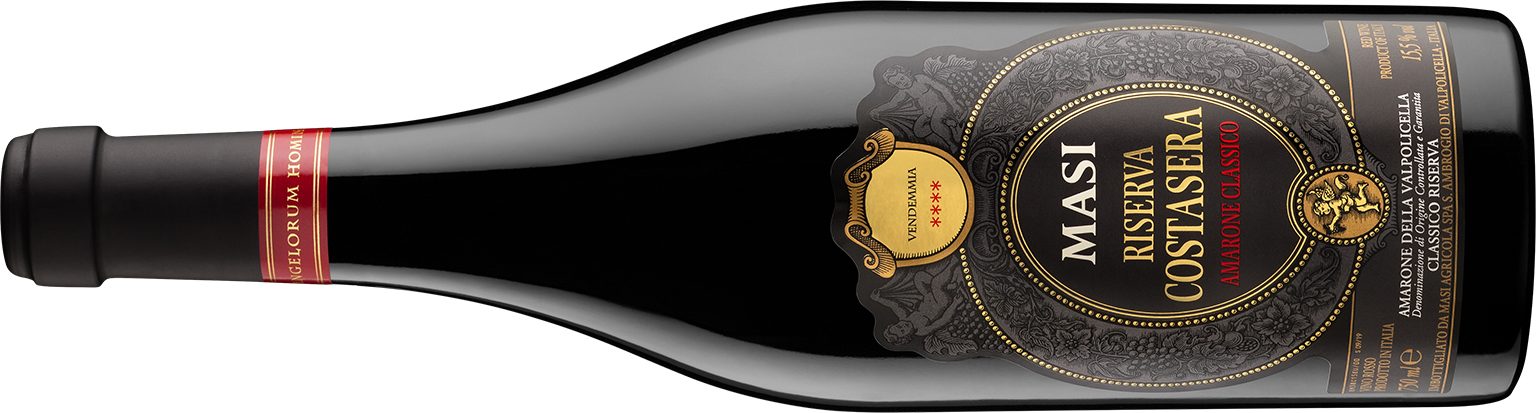
Costasera Riserva Amarone represents the pinnacle of luxury from Valpolicella—an elevated expression of Amarone that demonstrates Masi’s mastery and relentless pursuit of refinement. Crafted from select west-facing (“costa”) hillside vineyards in the heart of Valpolicella Classico, where evening sun and extended ripening lend concentration and aromatic purity, this cuvée stands apart.
The grapes undergo an extended appassimento of more than 120 days resulting in profound richness and textural depth. The blend incorporates Oseleta, a rare indigenous Veronese grape revived by Masi for its compact tannins, structural intensity, and exceptional ageing potential. After approximately 36 months in oak followed by six months bottle rest, the wine emerges after four and a half years of careful maturation, fully formed as the flagship of Masi’s Amarone expertise.
From vineyards across Marano, Negrar, Sant’Ambrogio, and San Pietro in Cariano, where the red limestone and basalt-rich soils provide outstanding drainage and mineral complexity, this 2018 is a study in both terroir and time.
Deep garnet with a subtle brick rim, signalling both youth and future evolution. The nose is intensely expressive: dark cherry, blackberry compote, and dried figs layered with roasted cocoa, sandalwood, balsamic tones, and truffle. Hints of tobacco leaf, graphite, savoury herbs, and spice unfold with air. On the palate, it’s full-bodied, richly textured, and impeccably balanced—the concentration from extended appassimento beautifully supported by fresh acidity and finely structured tannins from the addition of the Oseleta grapes. Flavours of dried red and black fruit, espresso, dark chocolate, leather, and sweet spice expand into a long, persistent finish marked by lingering balsamic warmth, echoing fruit, and mineral tension. A powerful yet refined Amarone, built to evolve gracefully for decades. 95 points.
🌡 Myth 3: “Niagara’s cool climate can’t produce full-bodied red wines.”
➤ Wine Showcase: Ultra-Premium Niagara Merlot from Kirby Estate (2020 Signature Merlot)
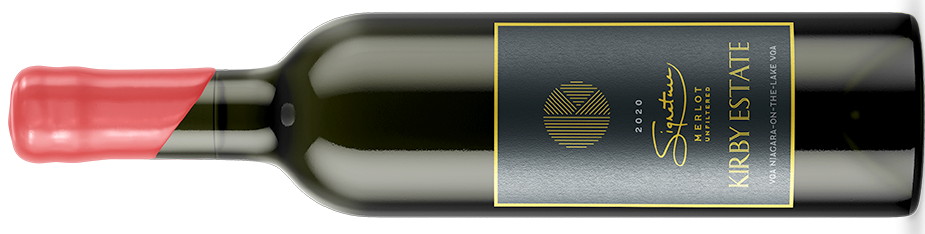
While Niagara is renowned for their world-class cool-climate Chardonnay, Riesling, and Pinot Noir, it’s often assumed that Niagara is too cool to fully ripen big, bold red grapes. This Merlot proves otherwise.
Niagara’s climate is classified as cool-climate, yet its growing degree days (GDD) tell a story of capability rather than constraint.
- Niagara-on-the-Lake typically accumulates 1,350–1,500 GDD (°C) annually.
- This range is similar to Pomerol, Bordeaux, home to Chateau Petrus—often the most expensive Merlot-based wine in the world, with iconic vintages selling for tens of thousands of dollars per bottle.
Niagara benefits from a longer, slower ripening season thanks to Lake Ontario, allowing grapes to reach full maturity well into late October or early November. This gradual ripening maintains vibrant acidity—something often lost in hotter regions where sugars rise rapidly before phenolic ripeness is achieved.
Through low-yield viticulture, canopy precision, and strategic harvest decisions, local producers are crafting Merlots with impressive structure and depth—showcasing that cool-climate wines, when intentionally grown, can rival world-class examples from warmer regions.
✔ Cool-climate wines can deliver depth, richness, and balance—when grown with intent.
✔ Niagara offers power with precision— Kirby Estate’s Signature Merlot is proof.
My review of the Kirby Estate 2020 Signature Merlot: Nestled in Niagara-on-the-Lake, Kirby Estate is positioning itself among Canada’s top-tier producers. Proprietors Scott and Maria Kirby have spared no effort in showcasing the full potential of their distinctive K-shaped estate vineyards (as depicted on their label). Supported by renowned viticulturalist Craig Wismer and winemaker Matt Smith, their philosophy is clear: precision farming, meticulous selection, and an uncompromising pursuit of quality.
The 2020 Signature Merlot represents the pinnacle of their craft. Sourced from 18-year-old vines planted in sandy loam soils, the grapes were handpicked in two lots (October 24 and November 7) at 23+ and 25+ brix, highlighting both patience and confidence in the growing season. After cold soaking, wild yeast fermentation, and 20 months in French oak (new and neutral), the wine was bottled unfiltered in July 2022 at 15.7% ABV. This alone speaks volumes about the exceptional ripening achieved in this cool-climate region.
Signature Merlot 2020 is a deep ruby colour with a subtle garnet rim. Fragrant and layered, offering sweet plum, blackberry, blueberry pie, cassis, and dark cherry, supported by savoury herbs, graphite, and crushed stone. A vibrant expression of both vintage ripeness and vineyard precision. Silky and powerful with exceptional texture. Velvety tannins frame concentrated dark fruit and spice, gradually unfolding into a long, graceful finish. Despite its 15.7% power, the wine remains refreshing and balanced, with cool-climate acidity adding lift and elegance to the full-bodied intensity.
A defining expression of Niagara Merlot: rich, structured, and beautifully composed, capturing remarkable ripeness while staying true to its origin. The 2020 Signature Merlot is a testament to what can be achieved when ambition, talent, and terroir align. The finest Niagara Merlot I’ve tasted. Enjoy now with a 2 hour decant or cellar and enjoy over the next 15–20 years. Tasted November 2025. 96 points. Matt Steeves – www.quercusvino.ca – Available winery-direct $108
🌊 Myth 4: “Where you store wine doesn’t really matter.”
➤ Wine Showcase: Benjamin Bridge Underwater Quest NV Rosé (Traditional Method Sparkling Wine, aged in the saltwater off the coast of Nova Scotia)
This innovative wine was aged in the Atlantic Ocean—an extreme example of arguably optimal wine storage conditions. Beneath the waves, it benefited from constant cool temperatures, complete darkness, and consistent pressure. While you don’t need an ocean cellar at home, the experiment brilliantly illustrates what wine needs to age gracefully.
At home, many wines suffer from the opposite conditions. Bottles are frequently stored:
- Above refrigerators, where warm air accumulates
- Beside stoves, radiators, or heat vents, exposing them to temperature spikes
- In sunlit kitchen windows, where direct light strikes the bottle daily
Exposure to heat and UV light accelerates chemical reactions, causing premature ageing, oxidation, and loss of freshness. Think of it like leaving fruit on a sunny windowsill—the bruising, deterioration, and dulling of flavour come quickly and permanently. Even short periods in improper storage can compromise quality before the wine is ever opened.
✔ Wine is best kept cool, dark, and undisturbed.
✔ A mild basement, interior closet, or wine fridge (set no lower than 10–12°C) is ideal.
✔ Avoid heat, light, and vibration—the three biggest enemies of wine.
Pro Tip: If you wouldn’t store gourmet chocolate there, don’t store wine there!
This underwater-aged wine is a dramatic reminder that environment matters. Whether in ocean depths or a home pantry, the right storage can preserve elegance, longevity, and expression.
Benjamin Bridge NV Rosé Brut – Underwater Quest
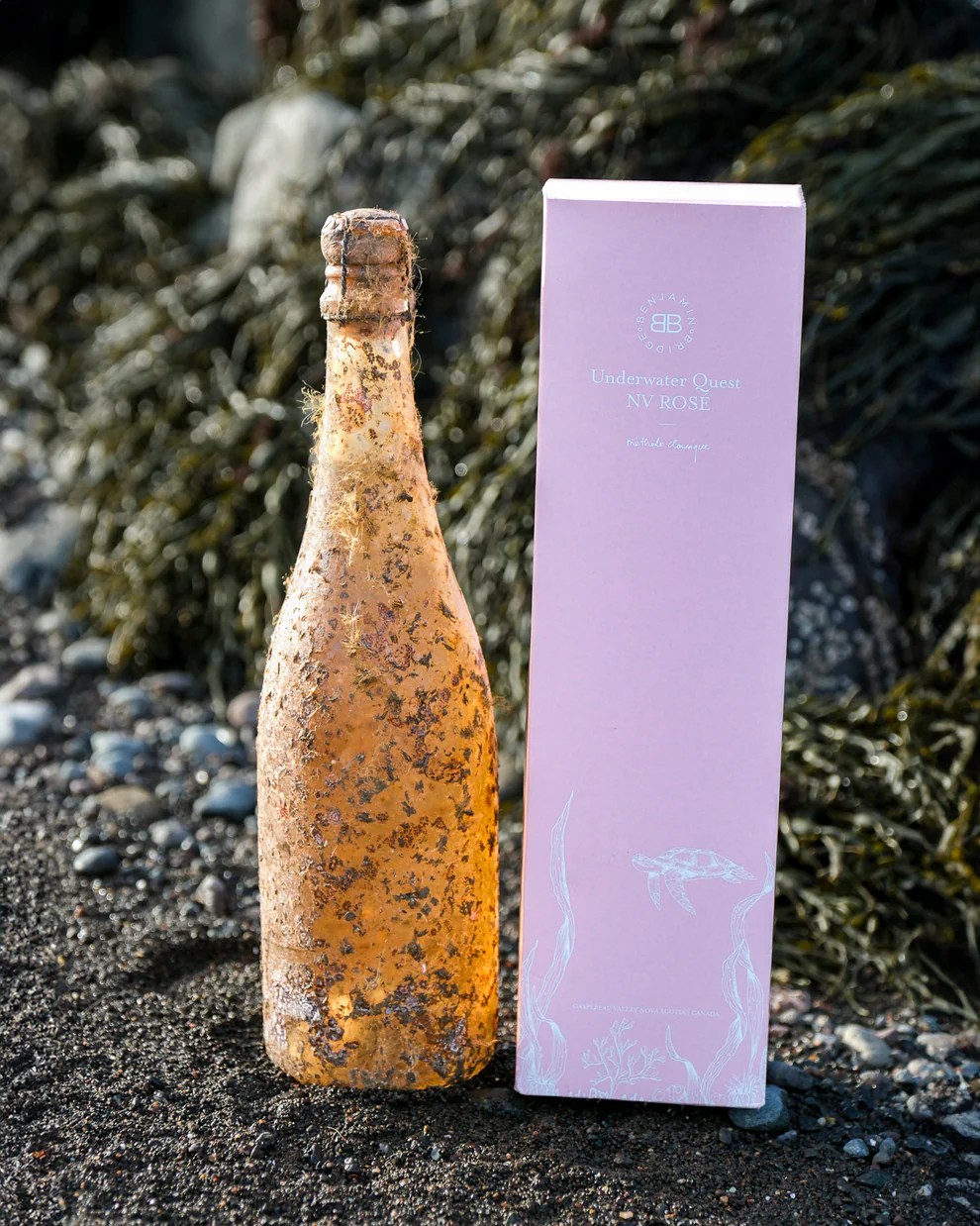
Inspired by the extraordinary preservation of centuries-old Champagne bottles discovered in Baltic Sea shipwrecks—still remarkably fresh after up to 200 years beneath the waves—Benjamin Bridge embarked on a daring experiment rooted in history, innovation, and curiosity. True to their pioneering spirit in sparkling winemaking, the team initiated an underwater aging project to explore whether the dark, cold seabed could serve as nature’s most unique cellar.
Fully aware of the risk of losing the entire production, they proceeded—motivated by a drive to push boundaries and supported by a gregarious winemaking team and local fishers who embraced the vision.
Earlier this year, Benjamin Bridge submerged several cages of their non-vintage Brut Rosé—a precise and exceptional traditional-method sparkling crafted from Chardonnay and Pinot Noir—off Nova Scotia’s rugged Eastern Shore. Months spent beneath shifting tides and among vibrant marine life led to the bottles resurfacing intact, naturally adorned by the sea and enriched by their underwater journey.
This unconventional storage represents the antithesis of how many wines are unfortunately kept. Where these bottles experienced constant cool temperatures, total darkness, and minimal disturbance, countless wines in homes are left sitting on top of fridges, beside stoves, near heaters, or in sunlit areas for days, weeks, even months. Such exposure to heat and light accelerates oxidation and degradation—some of the most damaging influences on wine. Instead, wines should be stored in cool, dark, stable environments, such as basement pantries or closets, or ideally in a temperature-controlled (but not overly cold) beverage fridge.
🍊 Bonus Myth: “Orange wine is made from oranges.”
➤ Wine Showcase: Therianthropy Mouflon Viognier/Marsanne/Chardonnay Orange Wine (2021)
Orange wine has nothing to do with citrus—it takes its name from its amber-orange hue, which comes from the way it’s made. Technically known as a skin-fermented white, this style involves white grapes being fermented with their skins, just like red wine production. This technique extracts additional tannins, aromatics, colour, and texture, resulting in a more layered and expressive wine.
In Ontario, under VQA guidelines, a wine labelled as “Skin-Fermented White (Orange Wine)” must:
- Use 100% white grapes, and
- Remain in continuous skin contact for a minimum of 10 days during fermentation (some producers go far beyond this).
- These wines may range from pale gold to deep amber in colour, depending on grape variety, length of maceration, and oxidation influence.
Therianthropy’s Mouflon Orange Wine is a prime example—crafted from Viognier, Marsanne, and Chardonnay, fermented on skins to reveal notes of tea leaf, apricot, wild herbs, and savoury minerality with that hallmark tactile grip.

🍷 Final Sip
Wine doesn’t have to be complicated to be extraordinary. Serve it properly, store it wisely, and stay open to discovery. Whether it’s a twist-top white, a powerful cool-climate red, sea-aged sparkling, or an iconic style like Amarone — the key is curiosity, not conformity. Afterall, wine is meant to be experienced, not overcomplicated.
👉 The best bottle isn’t determined by price, closure, or origin—it’s the one you enjoy, explore, and share.
Cheers,
Matt Steeves, Sommelier
QuercusVino.ca | @QuercusVino
Make a one-time donation
Make a monthly donation
Make a yearly donation
Choose an amount
Or enter a custom amount
Your contribution is appreciated.
Your contribution is appreciated.
Your contribution is appreciated.
Discover more from Quercus Vino
Subscribe to get the latest posts sent to your email.


Leave a Reply